- The Point by Modern Sciences
- Posts
- Alien Probes, Quantum Leaps, and Ancient Cats
Alien Probes, Quantum Leaps, and Ancient Cats
The Point by Modern Sciences - November 5, 2025

Don Smith
November 05, 2025

By The Modern Sciences Team | November 5, 2025 |
Happy Halloween, Cultivators of Curiosity!
Welcome to the 44th volume of The Point by Modern Sciences, where we explore the frontiers of scientific discovery. This landmark issue is dedicated to the new questions that arise when we challenge long-held assumptions about our universe, our technology, and even our own history.
We begin by looking to the stars at a mysterious interstellar visitor, 3I/ATLAS, and ask the tantalizing, if controversial, question: could we be looking at alien technology? Then, we bring our focus from the cosmic to the quantum, detailing a critical breakthrough that teleports information and brings the quantum internet one giant leap closer to reality. Finally, we turn to a more familiar subject with a surprisingly rewritten history, revealing how ancient trade, culture, and religion—not just utility—drove the spread of domestic cats across Europe. From the edge of our solar system to the future of our networks, this issue challenges what you think you know.
SPACE
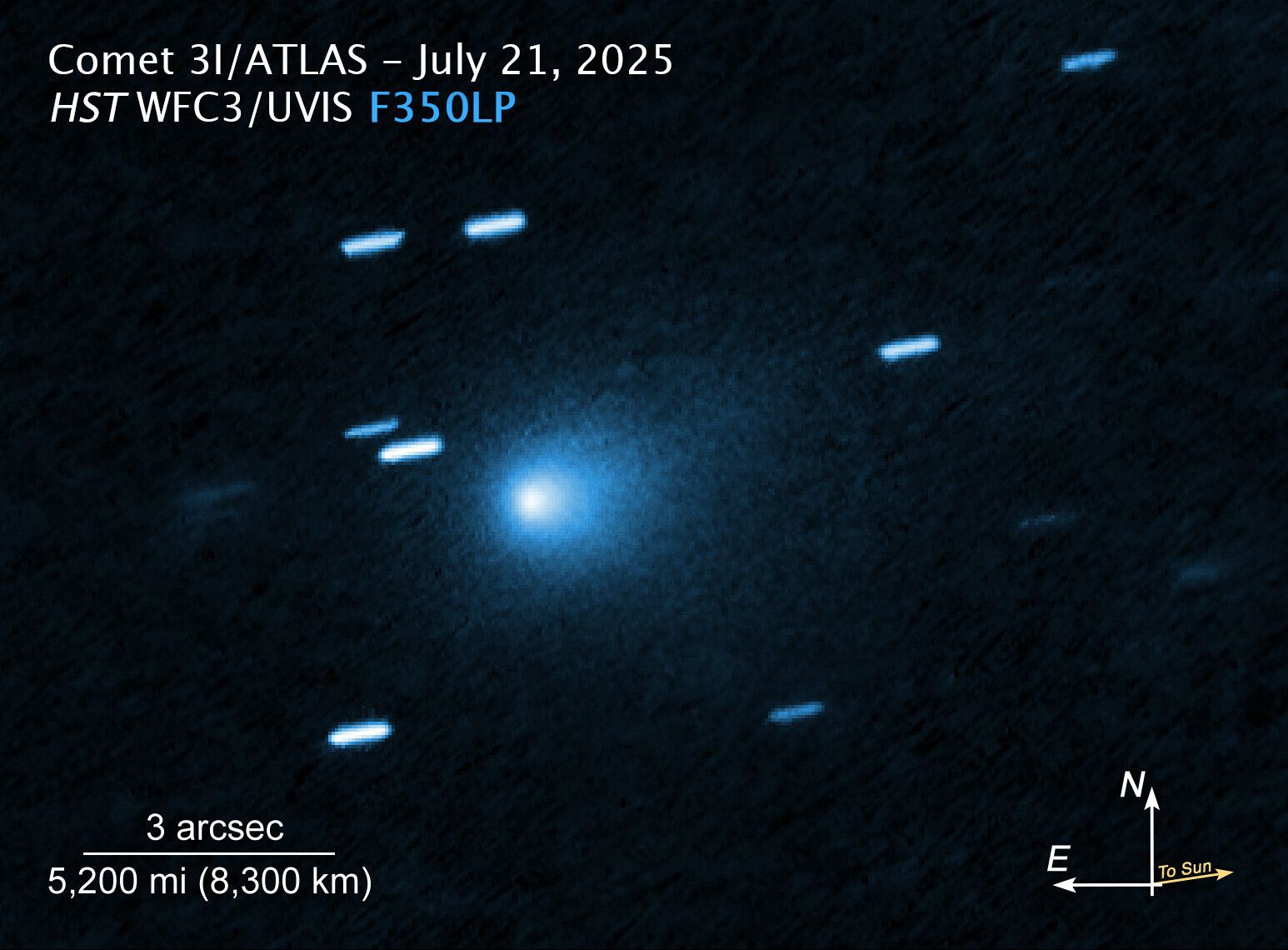
Could the latest ‘interstellar comet’ be an alien probe? Why spotting cosmic visitors is harder than you think
Astronomers have spotted 3I/ATLAS, a massive, high-speed interstellar object with properties so strange some are asking: could it be an alien probe? As the fastest object ever detected in our Solar System, its unusual trajectory has fueled scientific debate. This article explores the tell-tale signs that could distinguish this natural visitor from potential alien technology.
The Point:
Anomalous Interstellar Object: The discovery of 3I/ATLAS, a large and exceptionally fast object from outside our solar system, presents a unique case study for planetary science. Its extreme velocity and unusual orbit challenge current models of interstellar visitors.
The Alien Probe Hypothesis: A controversial paper speculates that 3I/ATLAS could be extraterrestrial technology, citing its improbable orbital path as potential evidence of deliberate navigation. This revives debate on how to identify signs of intelligence in cosmic objects, contrasting with the default assumption of natural origins.
Detection and Verification Challenges: Identifying a non-natural object requires looking for tell-tale signs like radio signals or course corrections, but our detection capabilities are limited to large or nearby objects. Without definitive evidence, the origin of ambiguous interstellar travelers like 3I/ATLAS remains a subject of scientific inquiry and speculation.
TECH
Scientists teleport quantum bit to solid memory
Researchers have successfully teleported a photonic qubit to a solid-state quantum memory, a significant milestone for creating a quantum internet. Using materials and light wavelengths compatible with existing fiber-optic networks, this work demonstrates a practical approach for generating, transmitting, and storing quantum information, thereby paving the way for scalable quantum communication systems.
The Point:
Quantum teleportation was achieved using telecom-compatible hardware: Scientists teleported a photonic qubit to an erbium-ion quantum memory, both of which operate at the 1.5-micrometer wavelength used in current fiber networks.
The system successfully integrates memory into the teleportation process: This demonstration is vital for building future quantum networks, where memories are needed to store information and extend entanglement distribution across long distances.
Results confirm a true quantum transfer, paving the way for scalability: Quantum state and process tomography demonstrated fidelities above the classical threshold, proving the system's effectiveness in creating large-scale quantum networks.
NATURE
New Studies Rewrite History of Domestic Cats' Spread Across Europe
New studies from the University of Rome Tor Vergata and the University of Exeter reveal that domestic cats spread across Europe in multiple waves, starting as early as the 1st millennium BCE. Contrary to earlier beliefs, cats arrived with cultural, religious, and trade influences, not just with Neolithic farmers. The research suggests Tunisia as the origin and highlights the competition with native wildcats.
The Point:
New studies challenge old beliefs on cat domestication in Europe: Genetic and archaeological evidence reveals that domestic cats arrived in Europe in multiple waves, starting around the 1st millennium BCE—not 6,000 years ago as once thought.
Research highlights cultural and religious roles in cats’ spread: The sacred status of cats in ancient Egypt and Iron Age trade helped drive their movement across the Mediterranean, not just their utility as rodent control.
The arrival of domestic cats sparked ecological shifts in Europe: The introduction of domestic cats led to competition with native wildcats, influencing their decline and reshaping Europe’s feline biodiversity.