- The Point by Modern Sciences
- Posts
- Signs of Life on Mars, a Volcanic Surprise, and the Universe's True Shape
Signs of Life on Mars, a Volcanic Surprise, and the Universe's True Shape
The Point by Modern Sciences - July 16, 2025 (A)

Don Smith
July 16, 2025

By The Modern Sciences Team | July 16, 2025 |
Hello again, Cultivators of Curiosity!
Welcome to the 28th volume of The Point by Modern Sciences, where we explore the discoveries that reshape our understanding of the world. This week, we’re examining the hidden structures that govern our universe, ranging from the molecular to the cosmic. These three articles reveal that whether we are searching for life on other worlds or examining our own, the universe is full of surprising and powerful connections.
First, we journey to Mars, where NASA's Curiosity rover has uncovered the largest organic molecules yet, offering tantalizing clues in the search for past life. Then, we return to Earth to witness how Kīlauea's eruption triggered a massive ocean bloom, revealing the profound impact of geology on our planet’s carbon cycle. Finally, we zoom out to ask one of the biggest questions of all: What is the actual shape of the universe? Explore how the abstract field of topology provides concrete answers and practical solutions to problems in robotics, biology, and beyond.
SPACE
NASA's ‘Curiosity’ Rover Discovers Key Organic Molecules on Mars
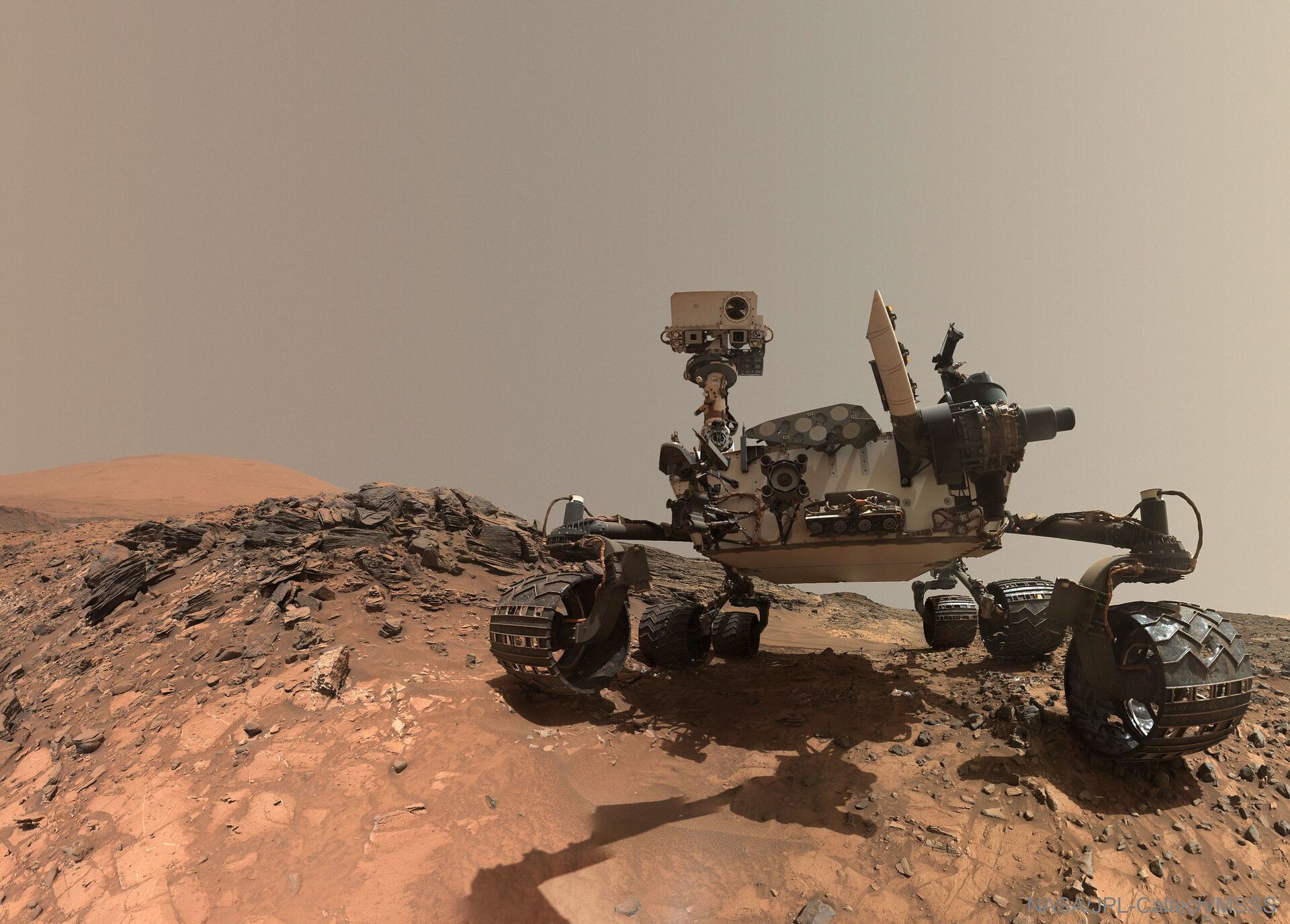
NASA's Curiosity rover has detected the largest organic molecules yet on Mars, offering tantalizing clues about the planet’s potential for past life. The discovery of compounds like decane within a Gale Crater rock sample strengthens the possibility that Mars once possessed the chemical ingredients necessary for life, though their exact origin remains uncertain.
The Point:
Curiosity rover uncovers new organic molecules on Mars: NASA scientists detected decane, undecane, and dodecane in a rock sample from Gale Crater—compounds that on Earth are typically linked to biological or prebiotic processes.
Findings hint at possible ancient Martian life conditions: These long-chain hydrocarbons may have originated from fatty acids, which are vital for forming cell membranes. This suggests Mars once had favorable conditions for life.
Discovery bolsters hope for future Mars exploration: While the source of the molecules is still uncertain, their presence supports the search for past life and highlights the need for sample return missions to deepen our understanding.

EARTH
Kīlauea Eruption Triggered Unprecedented Phytoplankton Bloom in the Pacific
In May 2018, Kīlauea's eruption triggered a massive phytoplankton bloom in the North Pacific, visible from space. The volcanic ash, rich in nutrients like iron, stimulated marine microorganisms, increasing carbon sequestration. This event, which removed carbon equivalent to half the CO₂ released by the volcano, underscores volcanic ash's role in ocean ecosystems and carbon cycling.
The Point:
Volcanic ash from Kīlauea triggered a massive phytoplankton bloom: The 2018 eruption sent nutrient-rich ash across the Pacific, fueling a bloom in the nutrient-poor North Pacific Subtropical Gyre that spanned an area five times the size of Taiwan.
Iron-rich ash boosted microbial growth in nutrient-depleted waters: Satellite data showed that volcanic ash stimulated the growth of nitrogen-fixing phytoplankton, revealing a powerful link between volcanic activity and marine ecosystem responses in otherwise barren ocean zones.
The bloom significantly enhanced carbon sequestration: As phytoplankton absorbed CO₂ and later sank, they helped remove atmospheric carbon—potentially offsetting up to half the emissions from the eruption—underscoring the role of natural events in Earth’s carbon cycle.
MATH AND THE SCIENCES
What’s the shape of the universe? Mathematicians use topology to study the shape of the world and everything in it
While your immediate world may seem flat, you live on a sphere. However, what is the actual shape of the universe itself? The mathematical field of geometric topology explores all possible spaces in every dimension, revealing its surprising relevance to real-world problems—from understanding DNA and planning robot movements to discovering the fundamental structure of our cosmos.
The Point:
Topology and the Universe’s Shape: Mathematicians use geometric topology to study the possible shapes of the universe, just as early explorers determined Earth’s shape. While we understand entirely 2D spaces, 3D and 4D spaces remain more complex, with implications for physics and cosmology.
High-Dimensional Spaces in Science: Beyond theoretical physics, higher-dimensional spaces have practical applications in robotics, space exploration, and data science. For example, tracking multiple robots in a factory requires understanding a 6D space, showing how topology helps solve real-world problems.
Knots and Their Scientific Significance: The study of knots—loops of string sitting inside 3D space—has become a central area of topology with applications in physics, biology, and chemistry. Understanding knots contributes to fields like DNA recombination and molecular structures, demonstrating the broad relevance of topology.