- The Point by Modern Sciences
- Posts
- A Habitable Super-Earth, a Math Breakthrough, and the Science Behind 'Starry Night'
A Habitable Super-Earth, a Math Breakthrough, and the Science Behind 'Starry Night'
The Point by Modern Sciences - June 11, 2025 (A)

Don Smith
June 11, 2025

By The Modern Sciences Team | June 11, 2025 |
Happy Wednesday, Cultivators of Curiosity!
Welcome to the 23rd volume of The Point by Modern Sciences! In this edition, we explore the shifting boundaries of human knowledge—where new frontiers open and old assumptions are challenged. We begin twenty light-years from home with exoplanet HD 20794 d; remarkable for its tantalizing proximity to Earth, it makes the abstract search for alien life a tangible, observable mission.
Next, we turn to the very fabric of reality, where the Alena Tensor offers a profound conceptual leap. It has the potential to dismantle the wall between general relativity and quantum mechanics, forging a unified map of the cosmos. Finally, we examine the intersection of art and science, where a debate over Van Gogh’s The Starry Night reminds us to distinguish between inspiration and evidence, preserving the integrity of both fields.
A short message from our friends at ElevenLabs
ElevenLabs is our favorite platform for AI-generated audio. We use it regularly to bring written content to life—whether it’s for narrating articles, sharing ideas, or creating hands-free learning experiences. It’s surprisingly easy to use, yet powerful enough to support complex projects. Here are just a few of the features we love:
Lifelike Voice Generation: Convert written content into ultra-realistic speech that sounds natural and engaging.
Podcast Creation: Turn any text, PDF, or link into a multi-voice podcast with GenFM—ideal for learning on the go or distributing audio content fast.
Voice Customization: Adjust tone, pitch, and style—or clone your own voice for a personal touch.
Multilingual Reach: Translate and dub content across 30+ languages while preserving tone and clarity.
Conversational AI: Build real-time, responsive voice agents that can handle dynamic back-and-forth dialogue.
Developer-Ready Tools: Easily integrate ElevenLabs into your own projects using fast, flexible APIs.
Strong Security: Your data is protected with enterprise-grade security, including SOC2 and GDPR compliance.
Try ElevenLabs for free before the trial ends:
https://try.elevenlabs.io/gs5z72a5o00z
(Díaz/SMM (IAC), 2025)
SPACE
Newly Discovered Exoplanet HD 20794 d Found in Habitable Zone of Nearby Star
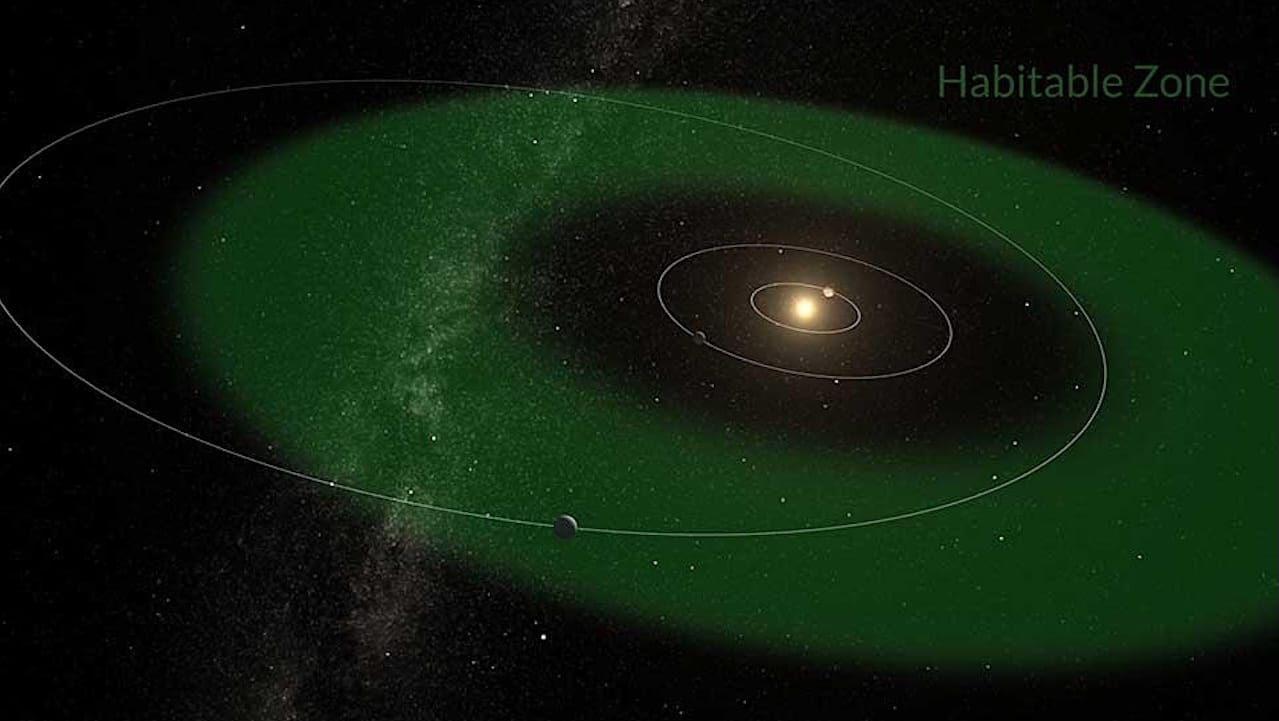
Researchers have discovered a new exoplanet, HD 20794 d (now known as 82 G. Eridani d), just 20 light-years from Earth. This "super-Earth," six times the mass of our planet, orbits within its star's habitable zone, where liquid water could exist. Its unusual elliptical path and proximity make it a prime target for future missions searching for signs of life.
The Point:
New Super-Earth Discovery: Scientists have confirmed the existence of HD 20794 d, a super-Earth six times the mass of our planet. It is located just 20 light-years away within the habitable zone of a sun-like star, where liquid water could potentially exist.
Detection Through Decades of Data: Using over 20 years of observations from HARPS and ESPRESSO spectrographs, researchers identified the planet by detecting minute shifts in its star’s light, confirming its presence through advanced analysis.
Potential for Future Exploration: With its elliptical orbit affecting its position in the habitable zone, HD 20794 d is a prime candidate for study by upcoming telescopes like the Extremely Large Telescope and the Habitable Worlds Observatory, offering insights into the conditions that might support life beyond Earth.
MATH AND THE SCIENCES
New Mathematical Discovery Could Unite Quantum Mechanics and General Relativity
A new mathematical discovery, the Alena Tensor, could finally reconcile two of physics' most important theories: general relativity and quantum mechanics. This breakthrough acts as a transformation tool, treating curved space-time as flat. The discovery helps explain fundamental particle properties like spin and could pave the way for a unified theory governing the universe.
The Point:
The Alena Tensor: Researchers have introduced the Alena Tensor, a mathematical object that may bridge the divide between general relativity and quantum mechanics. By describing curved space-time as flat, this tool holds promise for unifying these major physical theories into a comprehensive framework.
Breakthrough in Particle Behavior: Using the Alena Tensor, scientists discovered that charged particles, such as electrons, inherently possess spin and cannot remain completely still. This finding aligns with quantum mechanics and provides new insights into the relationship between mass, energy, and magnetic properties of particles.
Toward a Unified Theory of Physics: This discovery represents progress in the quest to unify quantum mechanics, general relativity, and electrodynamics. While still in its early stages, the Alena Tensor offers exciting potential for future breakthroughs, paving the way to understanding the universe's fundamental forces and structures.
MATH AND THE SCIENCES
Scientists Dispute Claims That Van Gogh’s ‘The Starry Night’ Depicts Fluid Dynamics
Van Gogh’s iconic The Starry Night has sparked a scientific debate. Some researchers claim that the swirling patterns in the painting mirror fluid dynamics. However, other experts argue that these swirls are purely artistic, challenging the idea that the masterpiece offers clues to turbulent fluid flows.
The Point:
Art meets science—but with limits: A recent debate questions whether van Gogh’s The Starry Night accurately represents turbulent fluid flows, as earlier research based on Kolmogorov’s turbulence theory suggested.
Experts push back on scientific claims: Fluid dynamics engineers argue the theory cannot apply to art, citing the absence of measurable physical properties like velocity or pressure in the painting.
Science-inspired curiosity, not conclusions: While the painting’s swirling beauty may spark scientific interest, experts stress that The Starry Night remains an emotional and artistic masterpiece—not a model of fluid behavior.