- The Point by Modern Sciences
- Posts
- Triceratops’ Strange Neck, a Universe Simulation, and a Quantum Leap
Triceratops’ Strange Neck, a Universe Simulation, and a Quantum Leap
The Point by Modern Sciences - March 20, 2025 (A)

Don Smith
March 20, 2025
In partnership with


By The Modern Sciences Team | March 20, 2025 |
Happy Thursday, Cultivators of Curiosity!
Welcome to the 11th volume of The Point by Modern Sciences, where we explore fascinating advances in paleontology, computational science, and quantum computing. This edition delves into the unique neck structure of the Triceratops, revealing how its extraordinary flexibility played a key role in its survival; the unprecedented simulation of the universe conducted by the world’s fastest supercomputer, shedding new light on cosmic phenomena; and IBM’s groundbreaking quantum computing experiment, which brings us closer to surpassing the limits of classical machines.
In these articles, we highlight how innovation continues to expand our understanding of both the past and the future. From the mysteries of ancient creatures to the forefront of technology in quantum computing, this volume offers fresh perspectives that push the boundaries of knowledge and technology, offering something to captivate every curious mind.
A short message from our friends at Merlin
Merlin is our team's favorite AI platform. We use it EVERY day. It is a powerful platform that allows you to access the best of every AI model. It is incredibly powerful, yet as intuitive as it could be. Here are a few of the many features that we love:
AI-Powered Assistance: Tap into advanced AI models like ChatGPT, Claude, Gemini, and more to revolutionize your productivity.
Interactive Chat Features: Enjoy the unique ability to chat directly with YouTube content and websites, making research and engagement effortless. Its Chrome extension makes it really easy to interact with all websites.
Comprehensive Toolset: Leverage an all-in-one suite of tools for task management, reminders, note-taking, and beyond—all designed to streamline your workflow.
Email Integration: Supercharge your email apps (like Gmail) with smart features that help cut down on drafting, replying, and organizing, so you spend less time on emails and more on what matters.
Seamless Mobile Experience: Stay connected on the go with an intuitive phone app that offers full functionality anytime, anywhere.
Enhanced Productivity: Combine cutting-edge AI with versatile tools to automate routine tasks and boost your efficiency across all digital platforms.
Robust Security: Rely on top-notch security measures that protect your data while ensuring a smooth and safe user experience.
Try Merlin for free using this link: https://fas.st/t/sv9iExbB
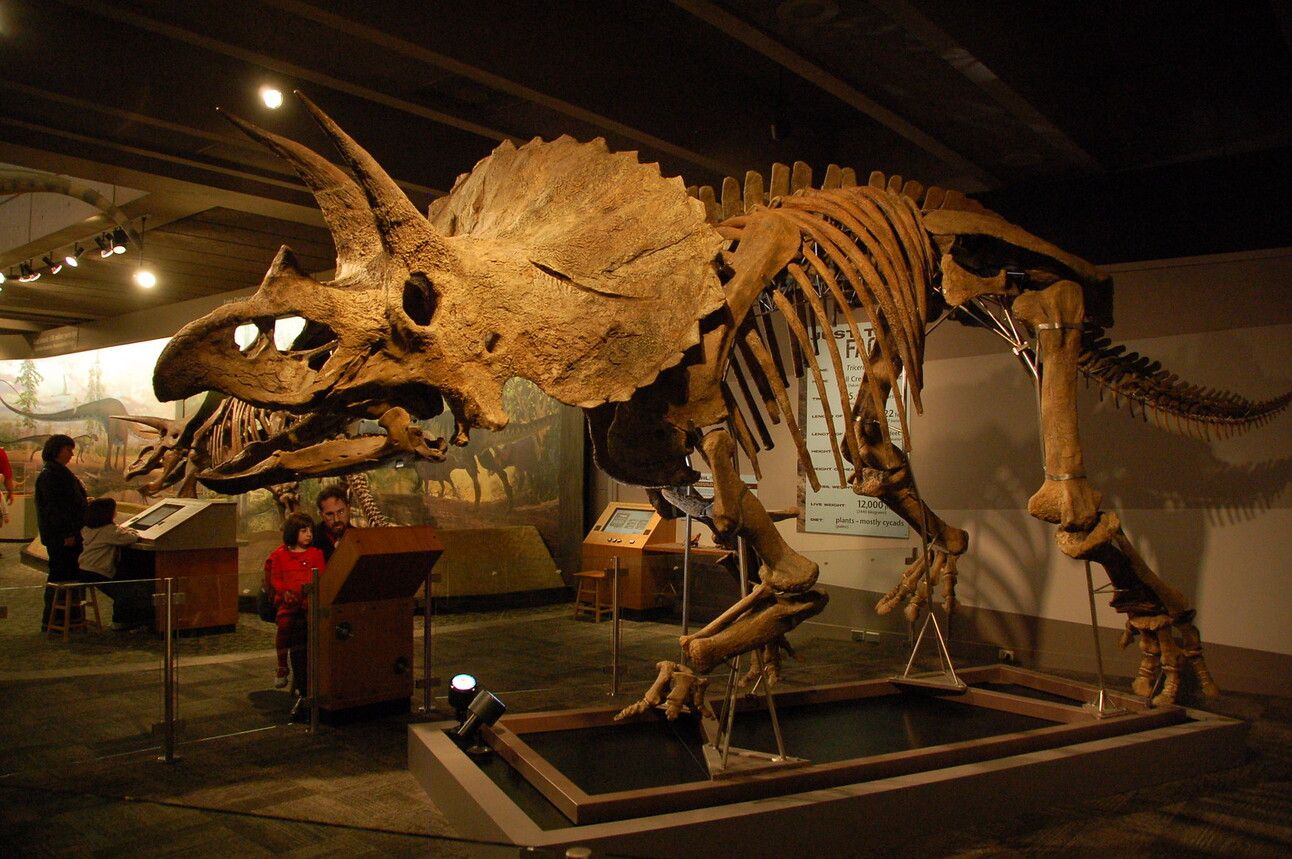
"Museum of Science: Fossilized triceratops, 'Cliff T. Tops'" by Chris Devers is licensed under CC BY-NC-ND 2.0.
NATURE
Triceratops Had a Pretty Weird Neck—Here’s Why It's So Unique
Triceratops are plant-eating dinosaurs that lived 68 to 65 million years ago, and likely went extinct due to the asteroid impact that wiped out the non-avian dinosaurs. Read more.
The Point:
Triceratops' Iconic Features: Known for its three horns and large frill, Triceratops had a beak-like mouth and plant-eating teeth, with its frill possibly used for attracting mates.
Unique Neck Joint: Unlike humans, Triceratops had a ball-and-socket joint at the base of its skull, allowing greater head movement for foraging and defense.
Evolution’s Creativity: The flexibility of Triceratops’ neck, combined with its heavy skull, showcases the diverse and fascinating ways evolution shapes animal anatomy.
The Daily Newsletter for Intellectually Curious Readers

Join over 4 million Americans who start their day with 1440 – your daily digest for unbiased, fact-centric news. From politics to sports, we cover it all by analyzing over 100 sources. Our concise, 5-minute read lands in your inbox each morning at no cost. Experience news without the noise; let 1440 help you make up your own mind. Sign up now and invite your friends and family to be part of the informed.
TECH
World's Fastest Supercomputer Simulates Universe at Unprecedented Scale
Researchers at Argonne National Laboratory used the Frontier supercomputer to run the most extensive astrophysical simulation ever, modeling both ordinary and dark matter interactions. Read more.
The Point:
Largest Universe Simulation: Using the Frontier supercomputer, researchers at Argonne National Laboratory achieved the most extensive astrophysical simulation ever. They modeled the interactions of ordinary and dark matter to better understand cosmic phenomena like galaxies, stars, and black holes.
Advanced Cosmological Modeling: The cosmological hydrodynamics simulation integrates gravity with atomic and dark matter behaviors, offering an unprecedented depiction of the universe's evolution and the formation of cosmic structures.
Exascale Power Unleashed: Leveraging HACC software optimized for Frontier's AMD GPUs, the team achieved simulations 300 times faster than previous platforms, producing insights aligned with real-world astronomical surveys and significantly advancing astrophysical research.
TECH
Quantum Computers on the Verge of Surpassing Classical Machines, IBM Experiment Shows
IBM scientists demonstrated that quantum computers could outperform classical computers in practical applications within the next two years. Read more.
The Point:
Breakthrough in Quantum Advantage: IBM's 127-qubit quantum computer, Eagle, successfully simulated the magnetic properties of a real material faster than classical computers by employing a specialized error-mitigating technique, signaling a potential quantum advantage within the next two years.
Overcoming Noise Challenges: By precisely measuring and compensating for qubit noise using advanced modeling, the experiment addressed a significant hurdle in quantum computing, enabling accurate results even in scenarios with strong entanglement where classical methods fall short.
Implications for Practical Applications: This achievement highlights the growing potential of quantum computers to solve complex, real-world problems in the pre-fault-tolerant era, paving the way for practical applications beyond the capabilities of classical systems.