- The Point by Modern Sciences
- Posts
- Asteroids, Ancient Impacts, and Crocodiles: New Scientific Frontiers
Asteroids, Ancient Impacts, and Crocodiles: New Scientific Frontiers
The Point by Modern Sciences - January 16, 2025

Don Smith
January 16, 2025
In partnership with


By The Modern Sciences Team | January 16, 2025 |
Welcome back, Cultivators of Curiosity!
Welcome to the second volume of The Point by Modern Sciences in 2025, where we explore the latest in planetary defense, ancient impacts, and wildlife conservation. This edition covers the European Space Agency’s Hera mission, set to investigate NASA’s asteroid deflection test; the newly uncovered Nadir Crater beneath the Atlantic Ocean, shedding light on Earth’s ancient past; and the intriguing return of saltwater crocodiles to Indonesia, raising questions about human-wildlife coexistence.
With each article, we delve into essential discoveries that expand our understanding of the natural world and highlight the delicate balance between progress and preservation. From space missions that could protect Earth from future threats to conservation efforts ensuring the survival of ancient species, this edition challenges us to think about the future, our environment, and our role in shaping both.
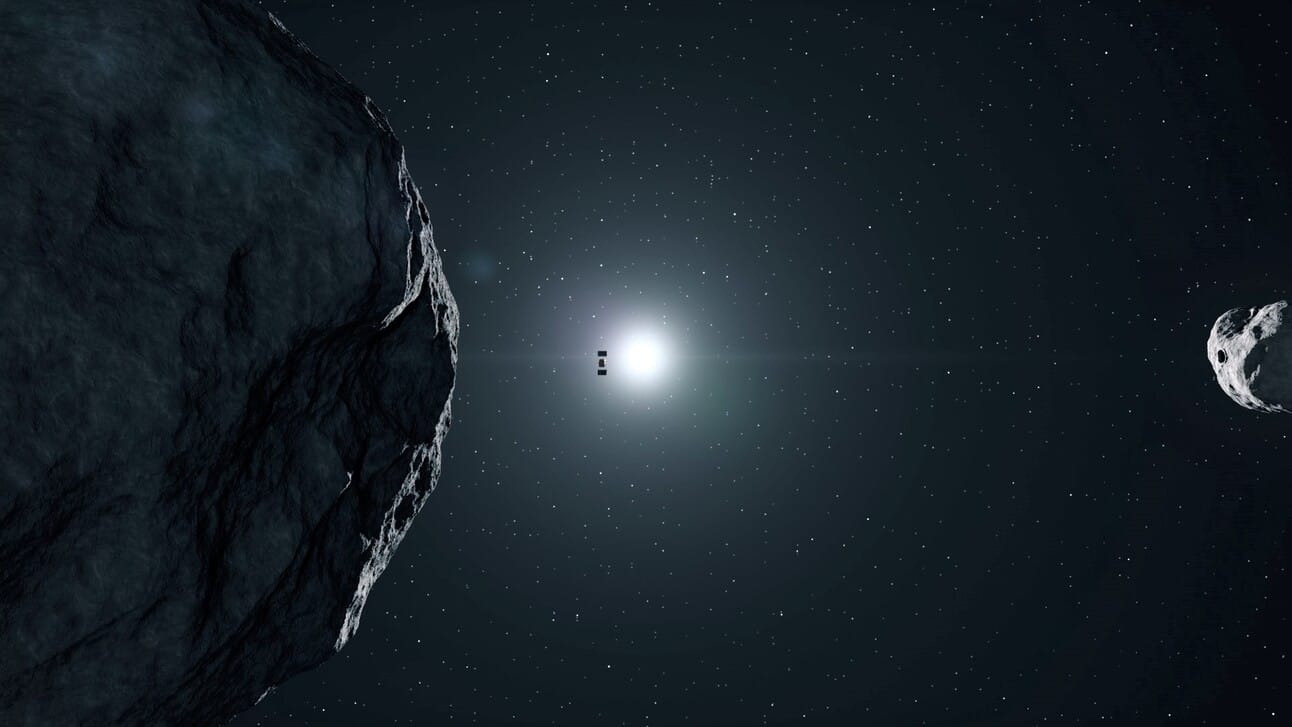
"Hera glides past Didymos" by ESA – Science Office is licensed under CC BY-SA 3.0.
SPACE
The ESA’s Hera mission takes flight toward the asteroid deflected by NASA’s DART probe two years ago
The European Space Agency's Hera mission will launch on October 7, 2024, from Cape Canaveral on a SpaceX Falcon 9 rocket. It will travel to the double asteroid system Didymos and Dimorphos, the same asteroid impacted by NASA's DART probe in 2022. Hera's goal is to study the effects of that impact and provide valuable information for future asteroid deflection efforts. Read more.
The Point:
Hera Mission Objectives: The European Space Agency’s Hera mission will follow up on NASA's DART asteroid deflection test. It aims to analyze the impact on the Didymos-Dimorphos system, providing crucial insights for future asteroid deflection techniques.
Key Instruments and Data Collection: Hera will carry two CubeSats equipped with advanced instruments to measure Dimorphos’ mass, internal structure, and mineral properties. The mission includes visible, thermal, and hyperspectral imaging to study the asteroid’s transformation post-impact.
Broader Implications: Hera’s findings will validate impact models and refine predictions for deflecting hazardous asteroids, offering a scalable framework for planetary defense strategies.
Receive Honest News Today

Join over 4 million Americans who start their day with 1440 – your daily digest for unbiased, fact-centric news. From politics to sports, we cover it all by analyzing over 100 sources. Our concise, 5-minute read lands in your inbox each morning at no cost. Experience news without the noise; let 1440 help you make up your own mind. Sign up now and invite your friends and family to be part of the informed.
Photo by Pavel Danilyuk: https://www.pexels.com/photo/medical-professional-holding-test-tube-sample-8442543/
LISTS
Transform STEM Teaching in 2025 with Labster Virtual Lab Experiment Books
As we approach the new year, university and college professors in STEM fields are gearing up for another cycle of innovation, learning, and discovery. For educators working in allied disciplines such as biology, genetics, and biochemistry and studying human diseases, staying prepared with practical teaching tools and resources is key to maximizing the opportunities that 2025 will bring. If you're looking for a way to enrich your teaching arsenal with cutting-edge STEM educational tools, the Labster Virtual Lab Experiments book series might be the solution. Read more.
EARTH
Scientists Uncover Ancient Asteroid Impact Crater Beneath Atlantic Ocean
Researchers have studied the Nadir Crater, an asteroid impact site beneath the Atlantic Ocean, formed around 66 million years ago, coinciding with the Chicxulub impact. Read more.
The Point:
Discovery of Nadir Crater: Researchers used advanced imaging to investigate the Nadir Crater, a hidden impact crater beneath the Atlantic Ocean, formed around 66 million years ago, coinciding with the Chicxulub impact that led to the extinction of the dinosaurs.
Impact Analysis: The study revealed the crater's formation, including the liquefaction of surrounding rocks and an enormous tsunami over 800 meters high. The new 3D seismic data helped visualize these post-impact events with remarkable detail, akin to improvements in medical imaging technology.
Broader Implications: The research aims to explore how this ancient impact influenced Earth's geology and climate, with plans to drill into the crater to gather samples. These insights could illuminate Earth's history and help assess future asteroid impact risks.
NATURE
Saltwater crocodiles are slowly returning to Bali and Java. Can we learn to live alongside them?
Saltwater crocodiles, including Bali and Lombok, were historically present across Indonesia but were wiped out in many areas by the mid-20th century. Recent sightings suggest their gradual return to some regions. Read more.
The Point:
Crocodile Resurgence in Indonesia: Recent sightings and attacks highlight the return of saltwater crocodiles to areas like Lombok and Java, likely due to migrations from nearby islands such as Flores and Timor. However, limited habitat and human pressures restrict significant population recovery.
Human-Crocodile Conflict: The increasing presence of crocodiles poses challenges, especially in densely populated areas. Awareness campaigns and habitat conservation efforts are crucial to mitigate attacks while protecting this vital species.
Minimal Risk to Bali: Despite sightings, Bali's high population density and tourism reliance make a crocodile resurgence unlikely. However, nearby regions like Lombok may see small resident populations reestablish over time.